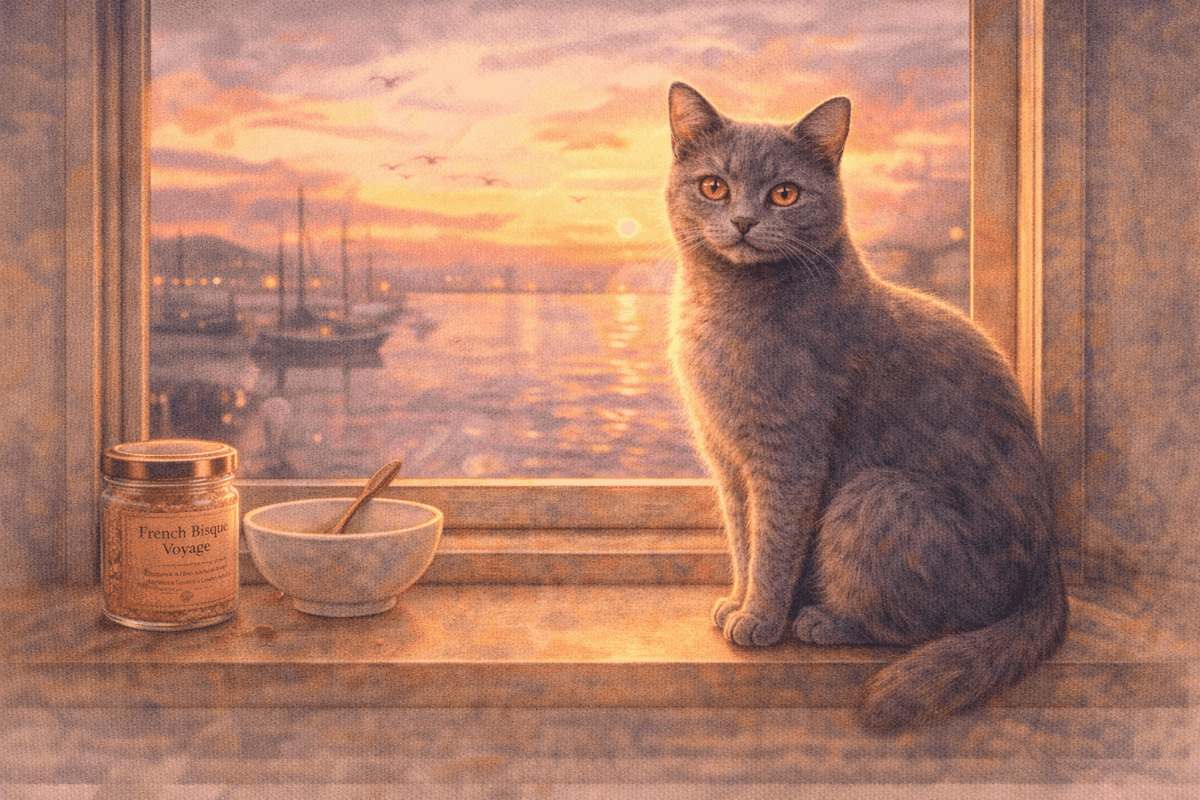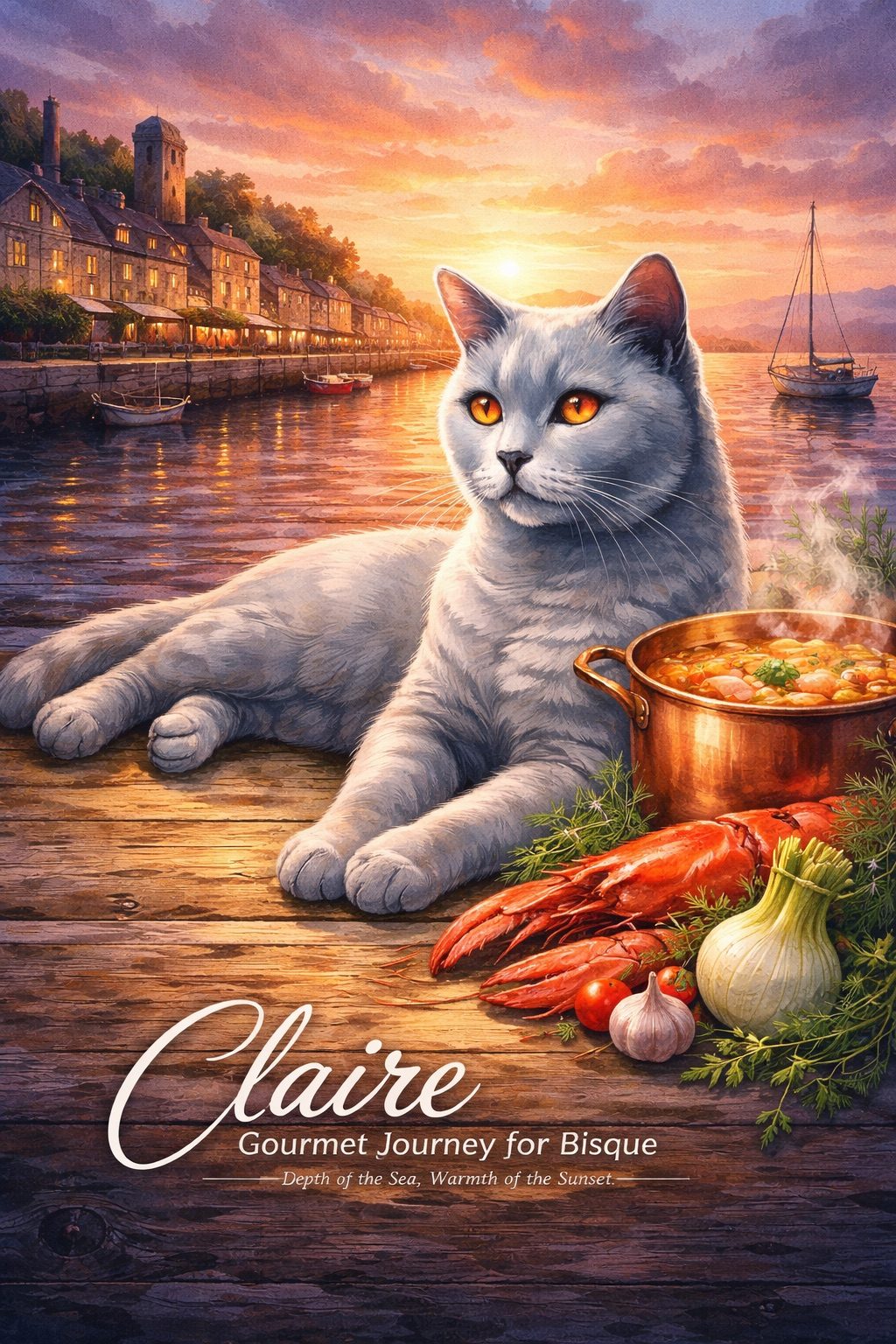
France's beloved "smiling cat," the Chartreux.
In a Brittany harbour town, she has long watched the fishermen simmer bisque in their copper pots.
With her solid frame and warm golden eyes, she quietly carries the richness of the sea's bounty.
Morning light spilled into the kitchen.
At the windowsill, that silver cat — Leila — was nowhere to be seen.
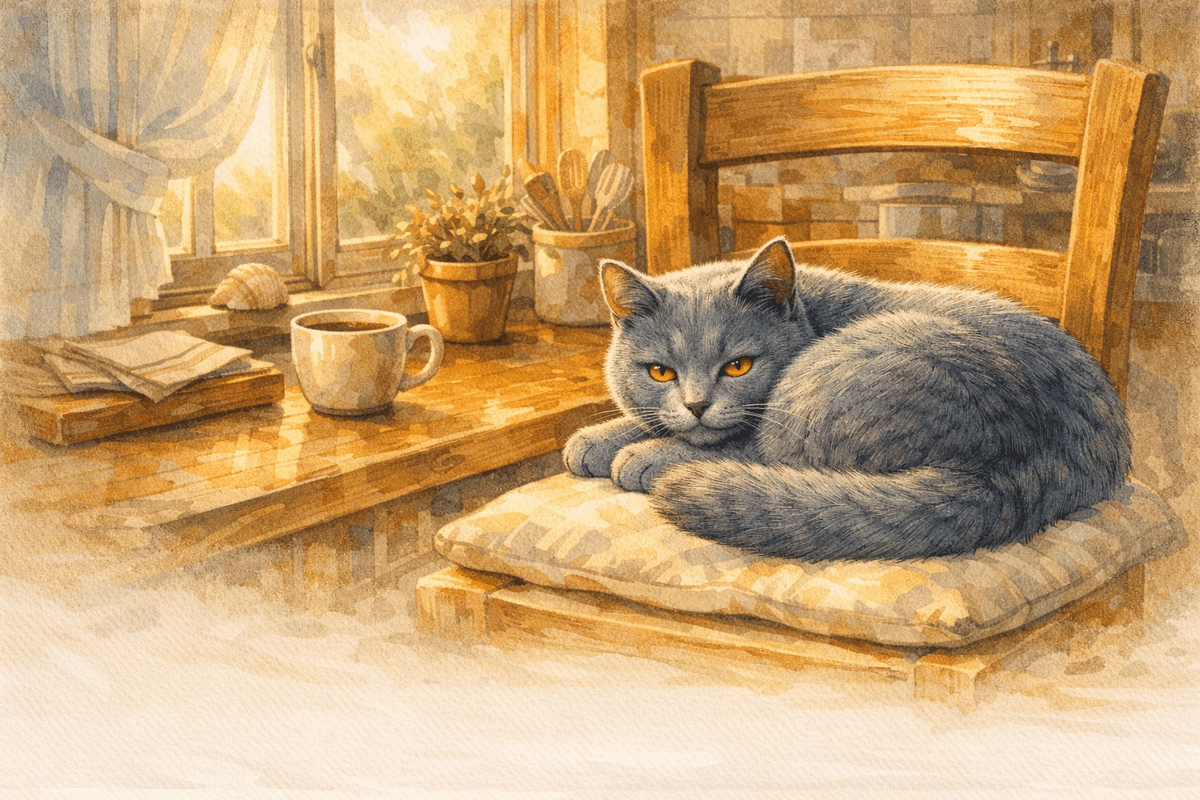
In her place, a cat had curled up on the chair, as if it had always been there.
Short, blue-grey fur. A solid, settled body.
A pair of copper eyes, fixed steadily on me.
Quiet eyes — yet somehow the eyes of a cat who loved to eat.
"And will you take me somewhere too?"
The cat rose slowly and turned toward the window.
From somewhere, the scent of the tide drifted in.
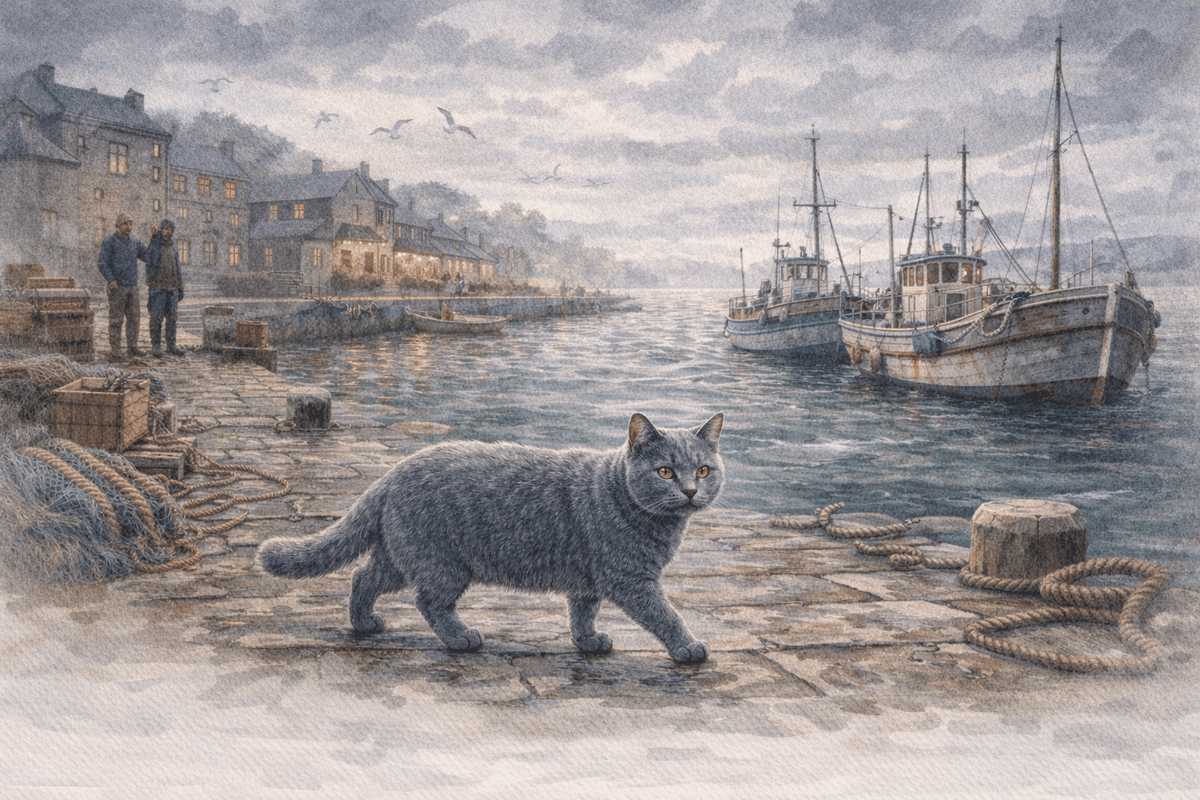
When I came to my senses, I was standing at a harbour.
Under a grey sky, fishing boats lined a stone jetty.
Gulls cried, and the waves slapped against the hulls.
The air was cold and damp.
And yet, somewhere within it, a warm aroma rode the wind.
Claire walked along the quay.
The fishermen called out, "Morning, Claire."
Here, it seemed, this cat was a familiar face.
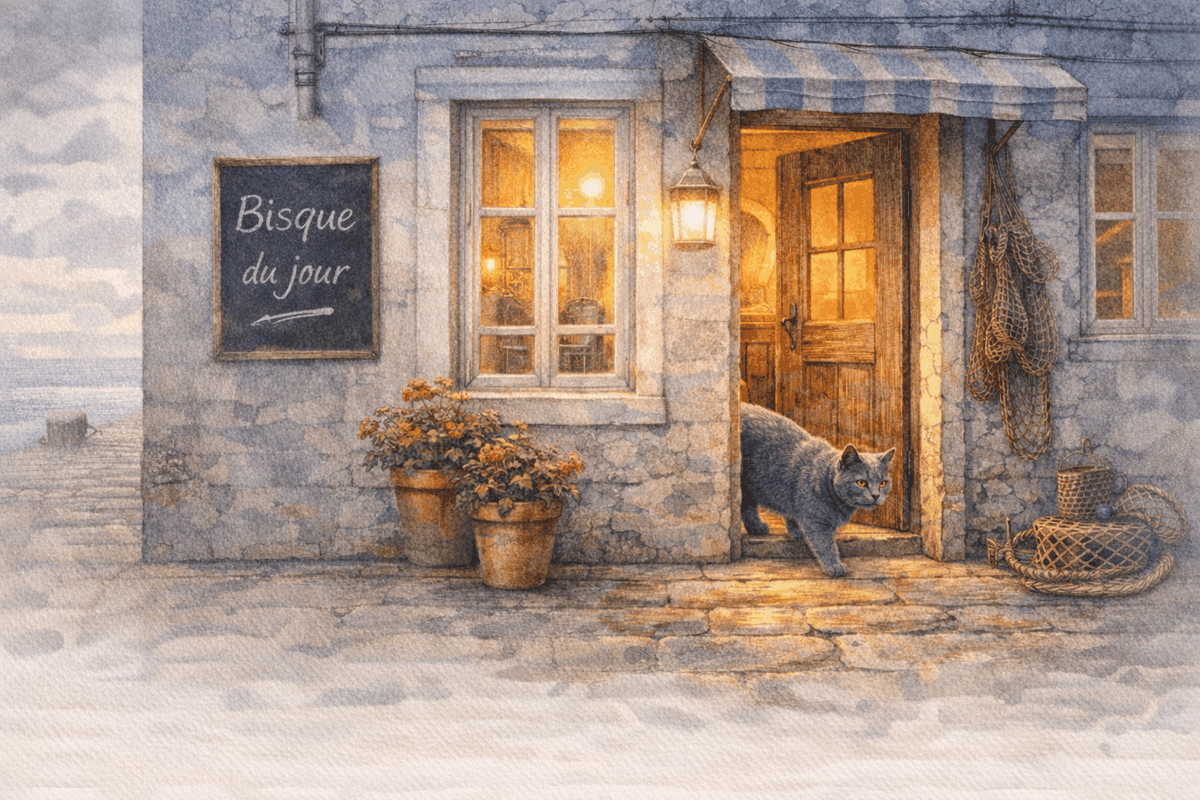
Just behind the harbour stood a small bistro.
Its walls were a pale blue, faded by the sea wind. The window frames were white.
Beside the door, chalked on a board, were the words "Today's Bisque."
Claire slipped in through the back entrance,
as though it were her very own home.
From inside came the chef's voice:
"Ah, Claire. Some fine shells came in today too."
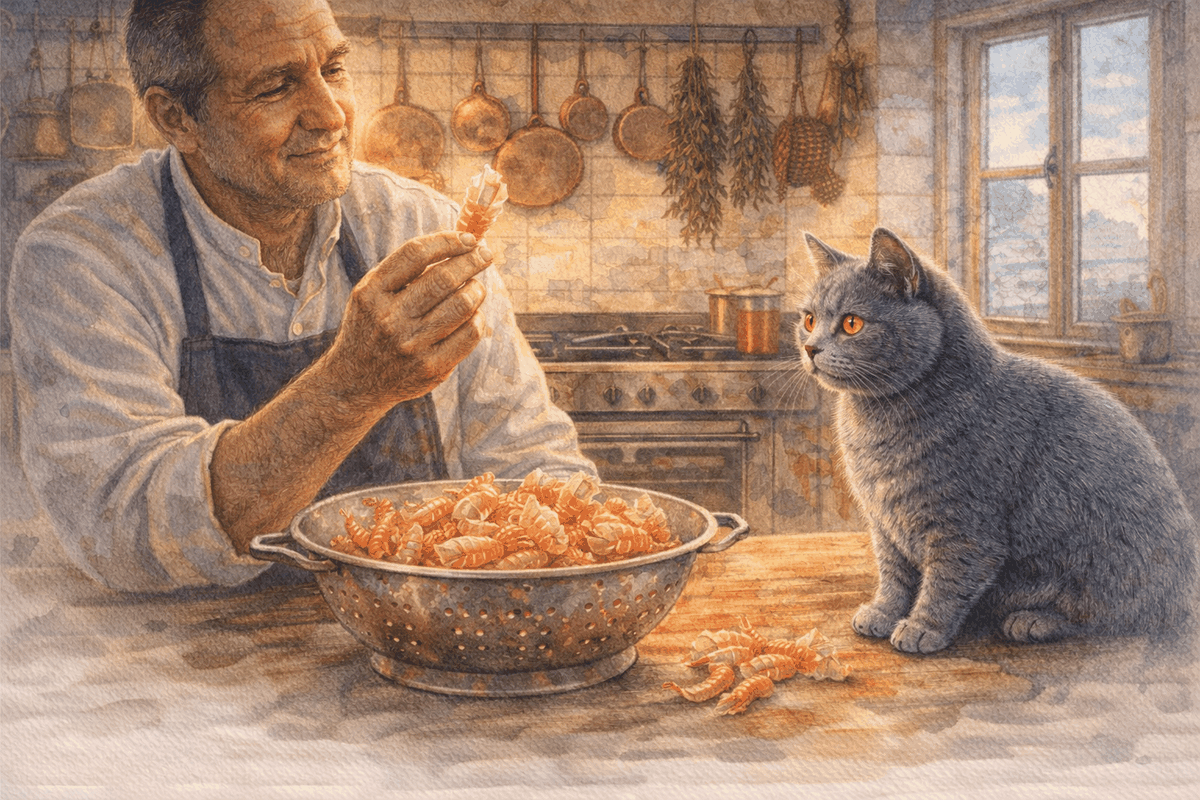
Inside the kitchen, the chef stood before
a great colander heaped with shrimp shells.
Thin shells, tinged with red.
The meat already taken, every one of them empty.
"These — they're no kind of rubbish, you know."
The chef lifted a single shell and brought it to his nose.
"Every bit of the sea's flavour is still right here."
— Really? In this shell?
The chef tipped the shells into a pan.
They crackled and snapped, and in an instant the kitchen filled with their scent.
The smell of shrimp shells toasting.
Fragrant, sweet, and deep.
"The secret of bisque, you see, is in these shells."
The chef went on talking, never pausing his hands.
"Long ago, the fishermen would take the small shrimp they couldn't sell
and boil them down whole, shells and all, to eat.
What was meant to be thrown away became the finest soup."
Over the sautéed shells he poured white wine.
It hissed, and steam rose up.
Onion, celery, garlic — the aromatic vegetables the French call mirepoix —
he added them and let it all simmer, slow and patient.
When the tomato went in, the soup turned a beautiful orange.
The chef took a spoonful to taste and nodded.
"This one's good today."
At his feet, Claire had closed her eyes, drinking in the aroma.
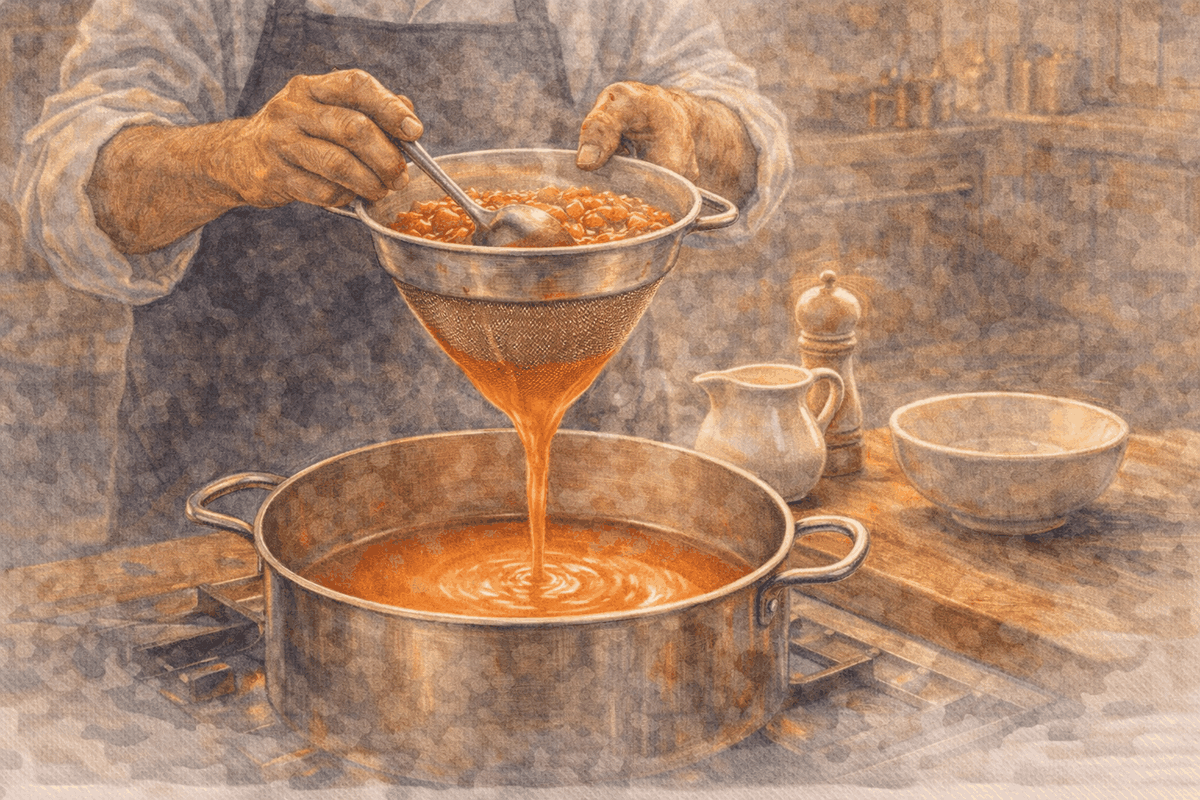
He strained the soup carefully through a chinois — a fine-meshed conical sieve.
Pressing down on the broken shells,
he wrung out every last drop of flavour.
What remained was a soup as smooth as silk.
To finish, a swirl of cream.
A single dusting of white pepper.
"This — this is bisque."
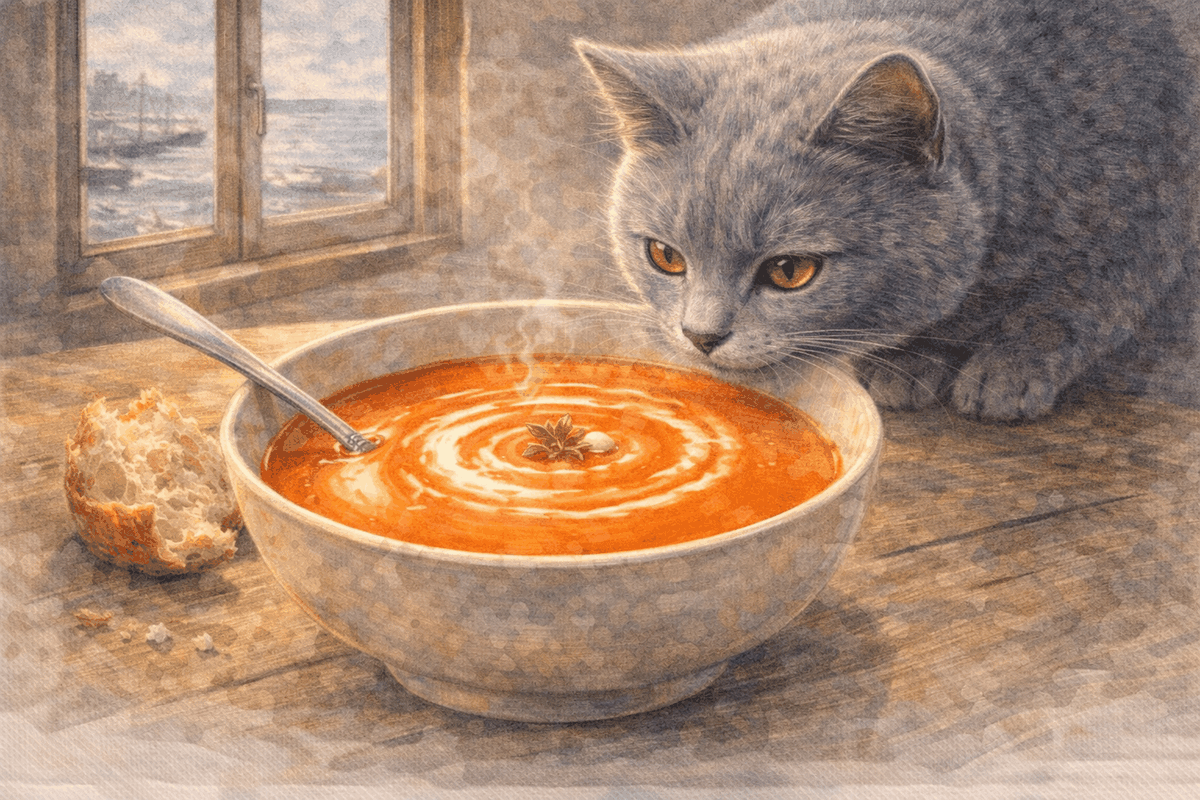
Poured into a bowl, the soup was
the sea itself, lit the colour of sunset.
One sip, and words failed me.
The shrimp's flavour bloomed slowly across my tongue.
Beneath the mellow richness of the cream
hid the toasted fragrance of the seared shells.
The bright, lingering depth of white pepper.
The sweetness of celery and onion.
So complex, and yet it slipped down so easily.
As if I were lifting the sea itself, spoonful by spoonful.
"It's delicious…"
Claire sprang up onto the table
and peered into the bowl.
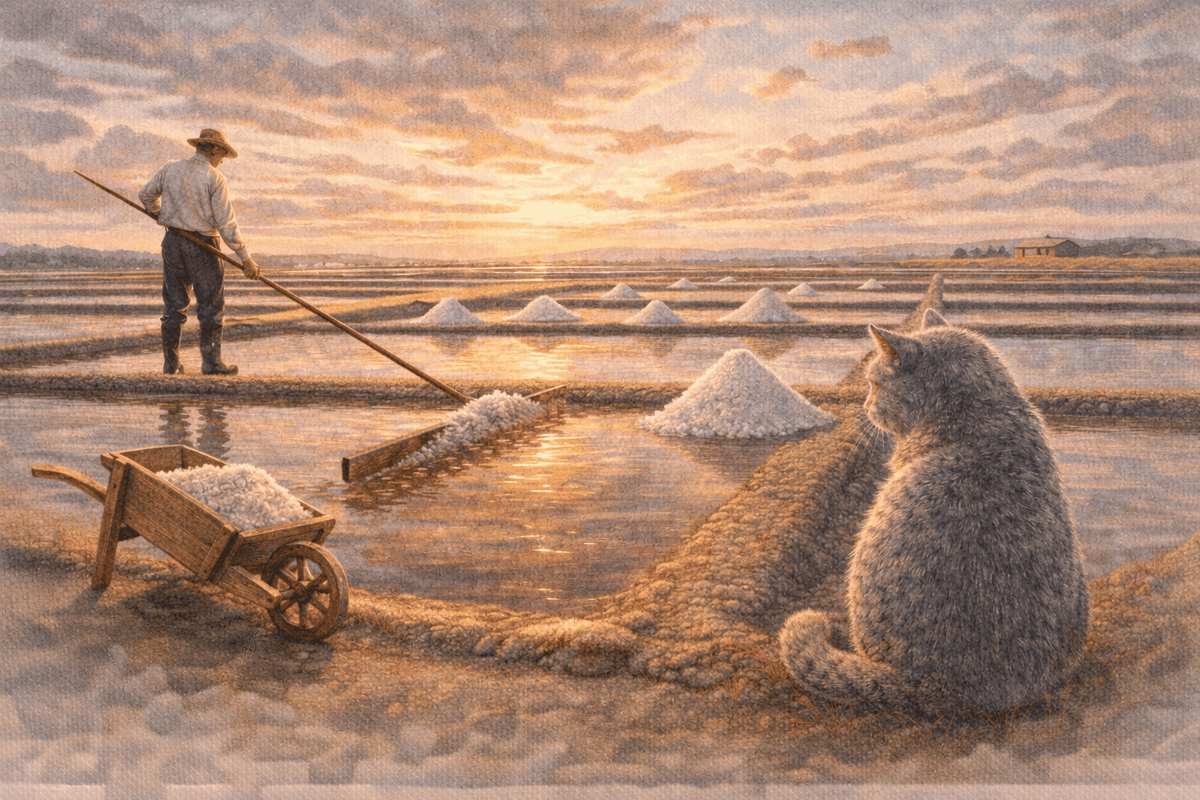
That afternoon, the chef took me to see the salt pans.
In the south of Brittany, a town called Guérande.
Shallow water stretched as far as the eye could see.
A salt worker — a paludier — gently gathered the salt
from the surface of the water with a long wooden tool.
"These salt pans have lasted more than a thousand years."
Salt made from wind and sun and seawater alone.
No machines. Only the work of human hands.
I placed a few grains on my fingertip and tasted.
Beneath the saltiness lay a faint sweetness.
As if the minerals of the sea had crystallised just as they were.
I came home to Japan.
Back to my usual kitchen.
But I couldn't forget the scent of that bisque.
The sea-fragrance of those shells, toasting in the pan.
The silken soup, strained through the chinois.
The round sweetness of Guérande salt.
"That taste — just once more —"
And then I remembered.
The shells of the "Angel Shrimp" that arrive from Okinawa.
The shells I always threw away after using the meat.
The chef's words came back to me.
"Every bit of the sea's flavour is still right here."
I carefully ground the shells of the Angel Shrimp into a powder.
Then I lined everything up on the table.
Sel Fin — the salt of Guérande.
Tomato powder. Cashew powder.
Smoked paprika. Garlic. Celery.
Onion. White pepper.
Recalling the taste of that bisque,
I mixed a little at a time, checking the aroma at every step.
The toastiness of the seared shells — that would come from smoked paprika.
The mellow roundness of the cream — from cashews.
And Guérande salt would gently draw the whole thing together.
"Ah — this is it."
It wasn't the bistro of Brittany.
And yet the air of that harbour came drifting softly back.
Tonight's dinner was cream pasta.
Usually it would be just bouillon and salt.
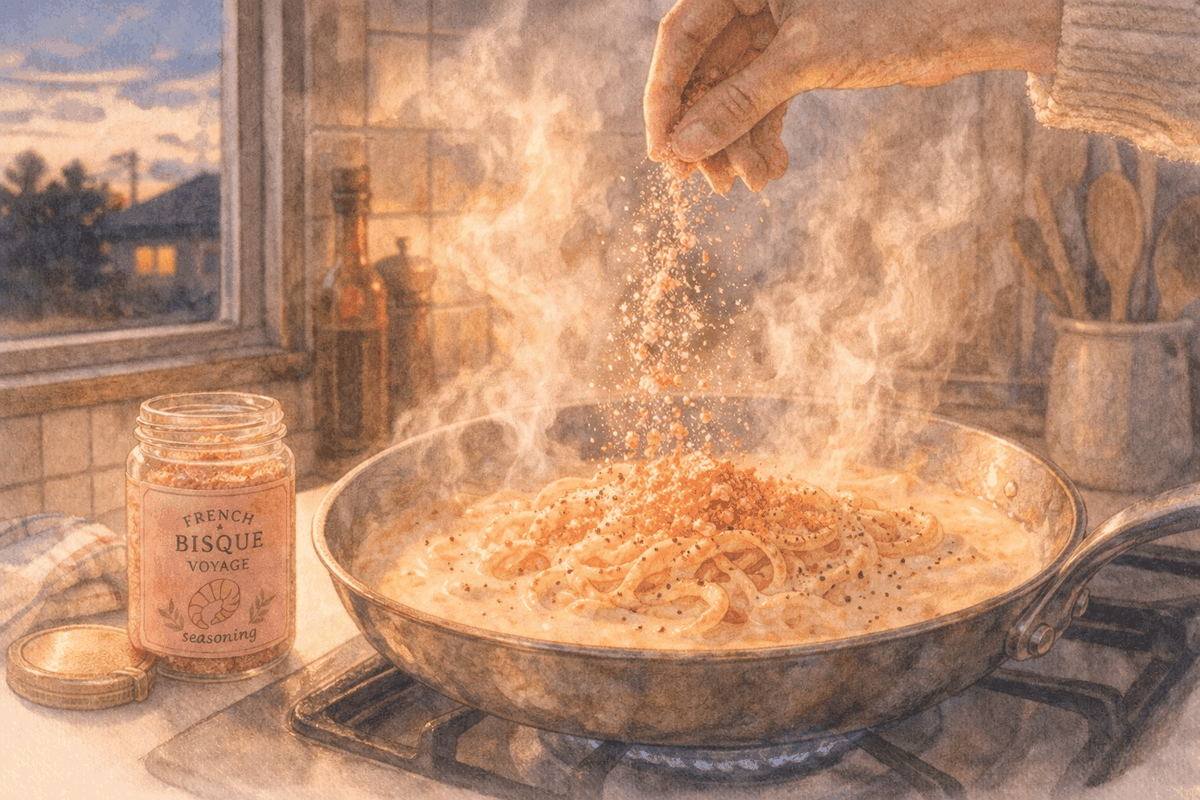
But tonight, a little chon-chon of that seasoning.
The aroma rose from the pan, and I caught my breath.
"…It's Brittany."
The deep flavour of shrimp shells.
The toastiness of smoked paprika.
The sweetness of Guérande salt, folded into the cream.
For a moment, the kitchen became that bistro in the harbour town.
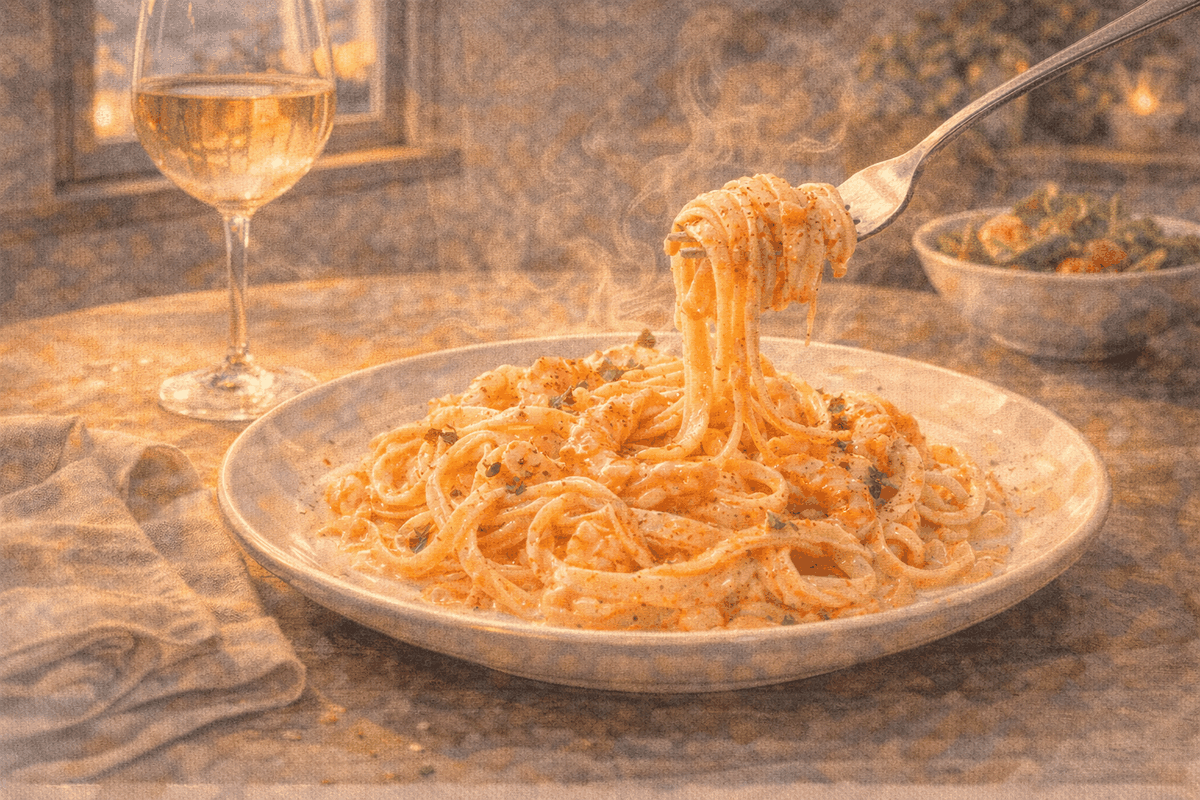
I took a bite.
Within the cream sauce coating the pasta,
the flavour of the shrimp was condensed, dense and full.
The mellowness of the cashews added a gentle richness,
different from the cream's. A faint tartness of tomato. The lingering note of smoked paprika.
This was no copy of Brittany's bisque.
It was a new flavour — one only a Japanese kitchen could make.
"Delicious. This is a seasoning of the sea."
At the windowsill sat Claire.
She had returned at some point, unnoticed.
Her blue-grey fur, lit by the setting sun,
shone the colour of the sea.
"Will you take me away again?"
Claire blinked slowly.
In her copper eyes glimmered the shimmer of waves.
Beyond the window, I sensed the presence of an unknown harbour.
What flavour might we meet next, I wondered.
The wisdom of 17th-century fishermen. A thousand years of Guérande salt. The shells of Okinawa's Angel Shrimp.
What was meant to be thrown away became the finest of flavours.
A single chon-chon over your everyday cooking,
and your kitchen connects to the sea.
The bisque cream pasta Claire discovered in the harbour town.
Fresh-cooked pasta, a touch of cream, and one little chon-chon turn it into a plate from a seaside bistro.
French Bisque Voyage — the depth of the sea, in a single shake.